



|
|
|
|
|
|
|
 other contests |
 back to main contest page |
|
Winners of the September - October 2004 Math Cats Writing Contest: |
 |
|
The contest rules were: __________
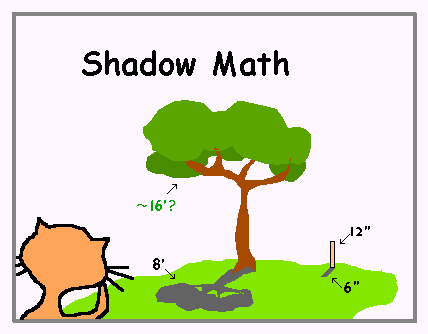
Explore "shadow math" and then write about it. Here are some possible ideas to explore:
__________
First Place - "Shapes and Proportions" - by Liana Kutos
Prize
* First Place:
Shapes and Proportions - by Liana Kutos
To do my shadow experiment I needed these materials: a paper cone, a tin can, a box, a cardboard poster, graph paper, scissors, and tape.
At 4:30 pm., I laid the poster on the side walk. I took the cone, and put it on the edge of the cardboard , and outlined the shadow with marker. I did the same thing with the box and the can. I repeated the experiment at 5:30 pm.
I compared the size of the shadow of the three objects for 4:30 pm and 5:30 pm. Even though the shadows grew much bigger at 5:30pm, the proportions of the objects, when compared to one another, stayed about the same. The depth of the can and the box added to the length of their shadows, but it didn't really affect the proportions.
Here is the data:
I used the graph paper to try to find the areas of the shadows in square inches. I traced the shadow shapes on graph paper and cut out the shapes. Next, I counted the squares to find the area of each shadow in square inches. The proportions of the areas changed from 4:30 p.m. to 5:30 p.m.
The judges felt that this entry was the clear winner. In fact, it was the only entry that explored shadow math! There is no second or third place winner this month.
* Prize
The first place prize is a Math Cats T-shirt and a large certificate.
* We're helping a special friend of Math Cats, too!
Wendy of Math Cats is making a donation to the IFOPA in honor of the winner and in honor of Jasmin Floyd, a young friend of Math Cats. You can learn about this worthy cause on the main contest page.
|
||||||||||||||||||||||||||
|
back to the main contest page |
| © copyright 2004 - by Wendy Petti of Math Cats. All Rights Reserved. |